The Surf Ski
Playbook
Mastering Downwind Energy
Downwind rewards timing — not effort alone.
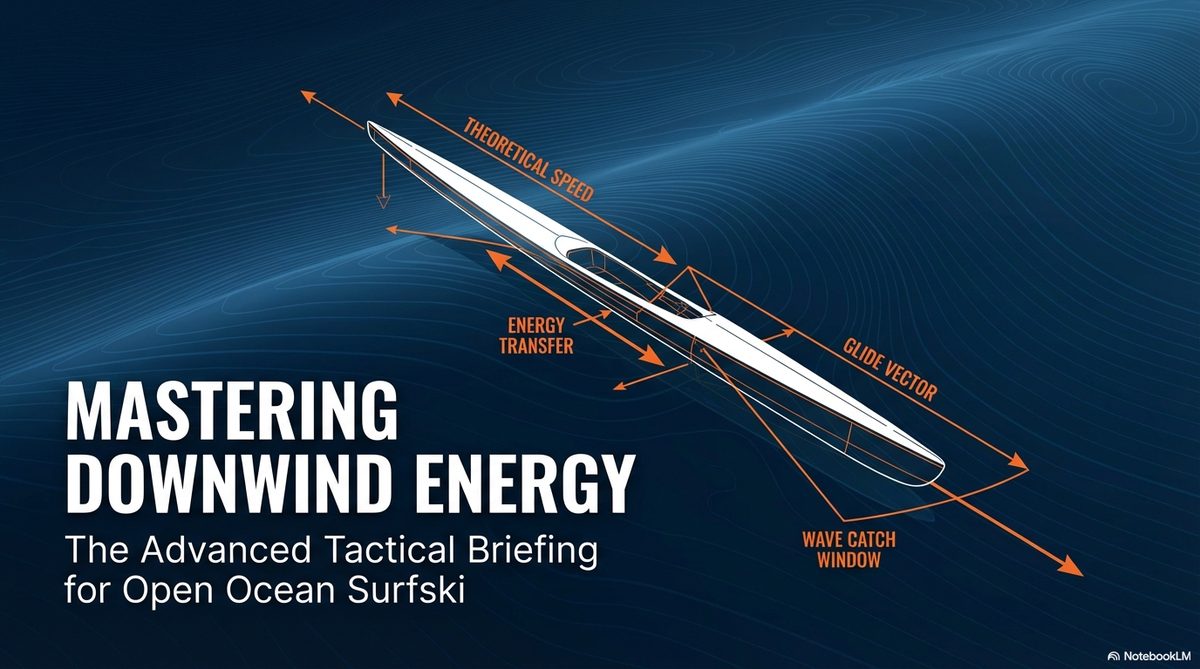
The Art of Stepping
Onto Moving Energy
Master the art of converting human effort into ocean energy. Flat-water paddling rewards the “grind” of constant output, but elite downwind performance demands a fundamental shift: you must learn to trade explosive power for sustained glide.
Success is not found in chasing water — it is found in stepping onto moving energy. The ocean is always generating power; your task is to intercept it, ride it, and sequence into the next piece before the current one expires.
This playbook contains eleven tactical frameworks built from the physics of open ocean movement. Each lesson builds on the last. Master them in sequence, apply them in combination, and the ocean becomes your engine.
The E·R Switch
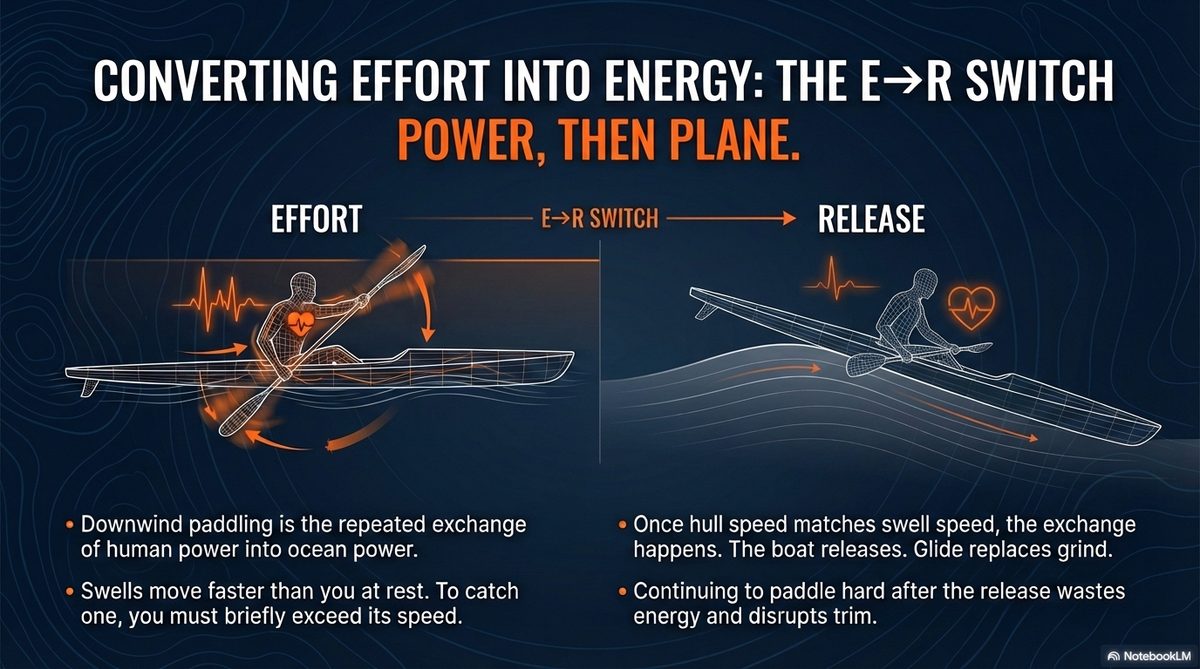
Execute the E→R Switch to transition from human-generated power to swell-generated momentum. Because swells travel faster than a paddler at rest, you must use explosive acceleration to briefly match or exceed the swell’s speed.
The moment the hull begins to lift and glide, you must cease the “grind” to maintain trim and preserve energy.
Phase 1 — Effort
- The ski is positioned on the back of a swell crest.
- High-intensity paddle force drives the hull forward.
- Turbulent white-water spray at the blade — you are fighting to match hull speed to swell speed.
Phase 2 — The Switch
The ski crosses the crest onto the face. This is the critical moment: feel the lift and stop grinding.
Phase 3 — Release
- Neutral glide position. Laminar, clean flow along the hull.
- The ocean is now the primary power source.
- Preserve trim. Protect the glide.
The S·M·G Ladder
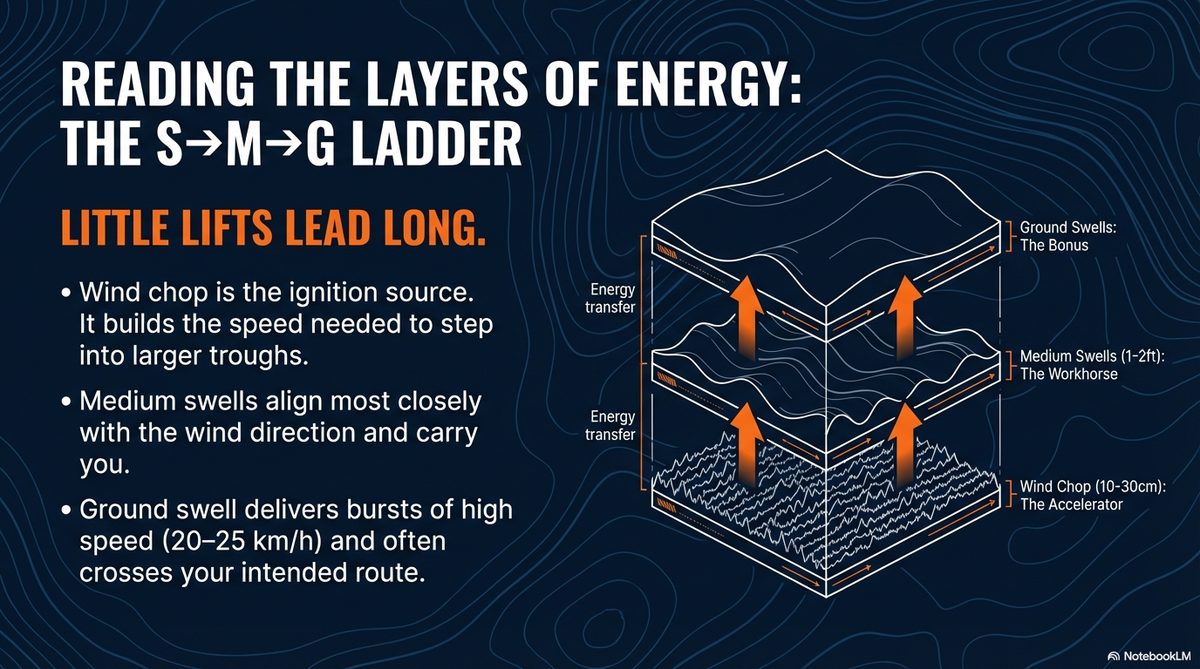
The ocean surface is a multi-layered environment of overlapping energy. To achieve maximum velocity, you must climb the S→M→G Ladder. Never wait for a ground swell to move you — use smaller energy as the ignition source to build the speed required to access the next rung.
The Rungs
- Small (Wind Chop): The ignition source. Accelerate here to build the baseline speed needed to catch larger runs.
- Medium (Wind Swell): These align with the wind and sustain your momentum between major surges.
- Ground (Ground Swell): The high-speed layer (typically 20–25 km/h). This provides the “Big Surge” but requires redirection back toward your route to avoid being pulled off-course.
Strategy
A vector path shows the ski stepping diagonally from a small ripple into a medium trough, building momentum to eventually drop into the fast-moving ground swell. This is your model — never passive, always climbing.
The 30·5·2 Rule
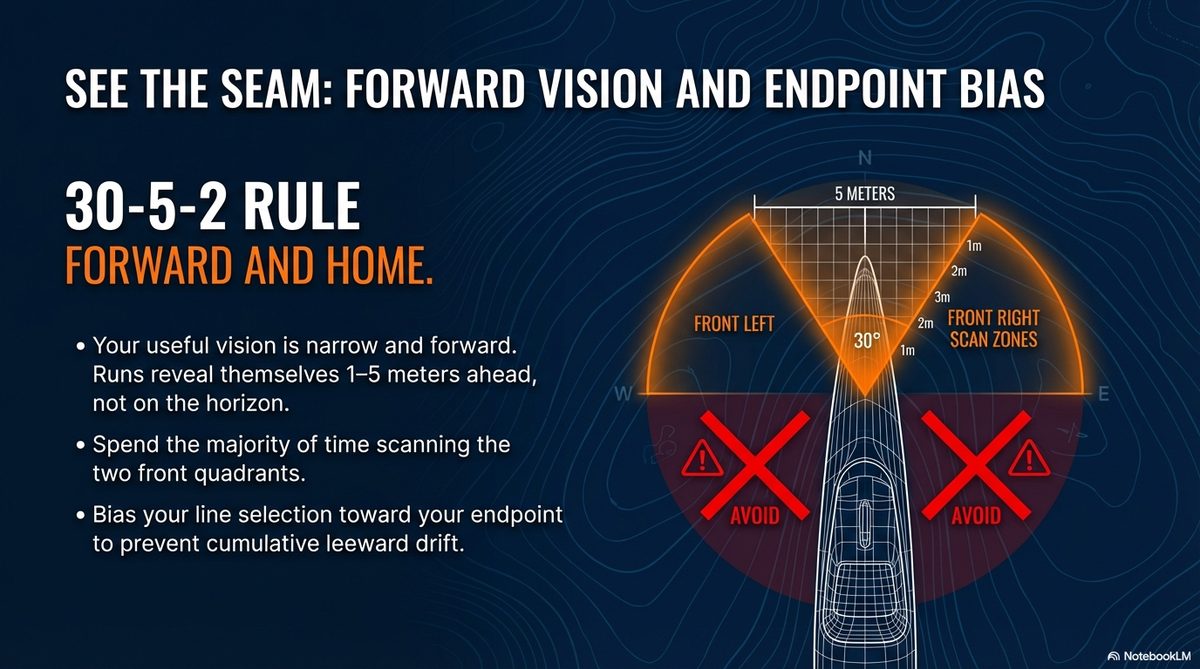
Technical navigation requires a narrow, forward-focused field of view. Looking behind disrupts your kinetic chain and balance. You must “hunt seams” — the subtle depressions where different swells connect — by adhering to the 30-5-2 Rule.
- 30° Forward: Your useful vision is restricted to a narrow 30-degree arc in front of the bow.
- 5 Metres Ahead: Scan the water 1–5 metres in front of your ski. This is where your immediate decisions are made.
- 2 Front Quadrants: Imagine a circle divided into four. Focus exclusively on the two forward quadrants.
Field Cues
- Hunt Ahead: Decisions are made 1–5 metres out.
- Bias Home: Always favour the quadrant that trends toward your destination.
- Forward Only: Looking back kills your momentum and balance.
The F² Rule
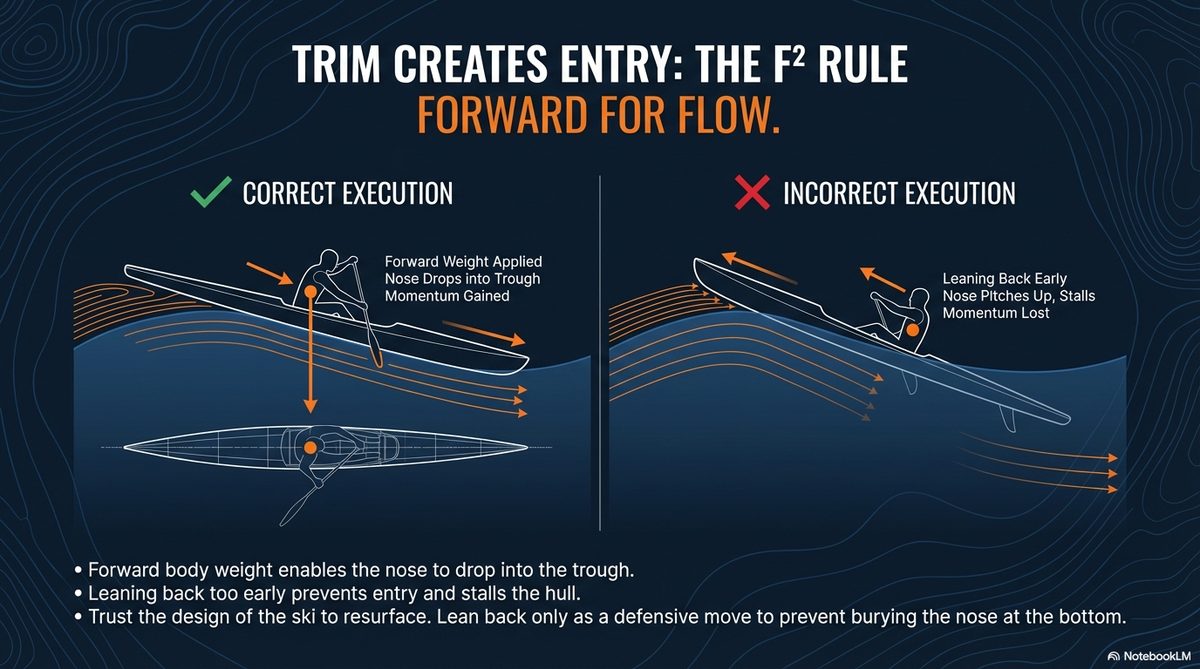
Nose trim is the mechanical key to entering a run. You must apply the F² Rule (Forward → Fall) to ensure the bow engages with the trough. Leaning back prematurely is a common error that kills acceleration and keeps the ski “stuck” on the crest.
Correct Execution
- Forward Weight Applied — nose drops into the trough.
- Momentum Gained — the hull accelerates down the face.
- The ski engages with the swell’s energy.
Incorrect Execution
Leaning Back Early → Nose Pitches Up → Stalls Hull → Momentum Lost. Trust the forward lean. The hull is designed for it.
Forward body weight enables the nose to drop into the trough. Leaning back too early prevents entry and stalls the hull. Treat the design of the ski to resurface — lean back only as a defensive move to prevent burying the nose at the bottom.
The C·G·C Sequence
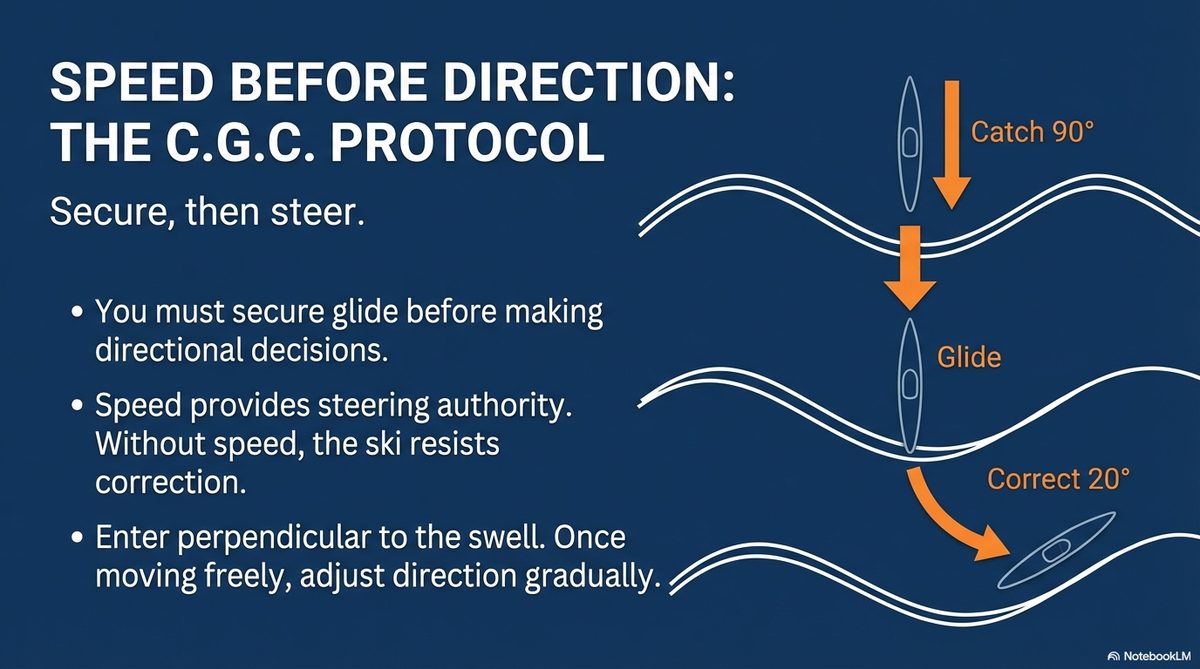
Speed provides steering authority. You must secure the glide before you attempt to correct your heading. If you attempt to turn without sufficient hull speed, the boat will stall. Follow the C.G.C. Sequence.
Step 1 — Catch
- Enter the swell at a precise 90-degree perpendicular angle.
- You must enter perpendicular to the swell to maximise the hull’s engagement with the face.
Step 2 — Glide
- Accelerate straight down the face.
- Do not attempt to steer yet. Speed is being established.
Step 3 — Correct
- Execute a subtle 20-degree arc at the bottom of the run.
- Redirect the ski toward your target destination.
- Speed provides the steering authority to hold the arc.
The H·A·L·T Strategy
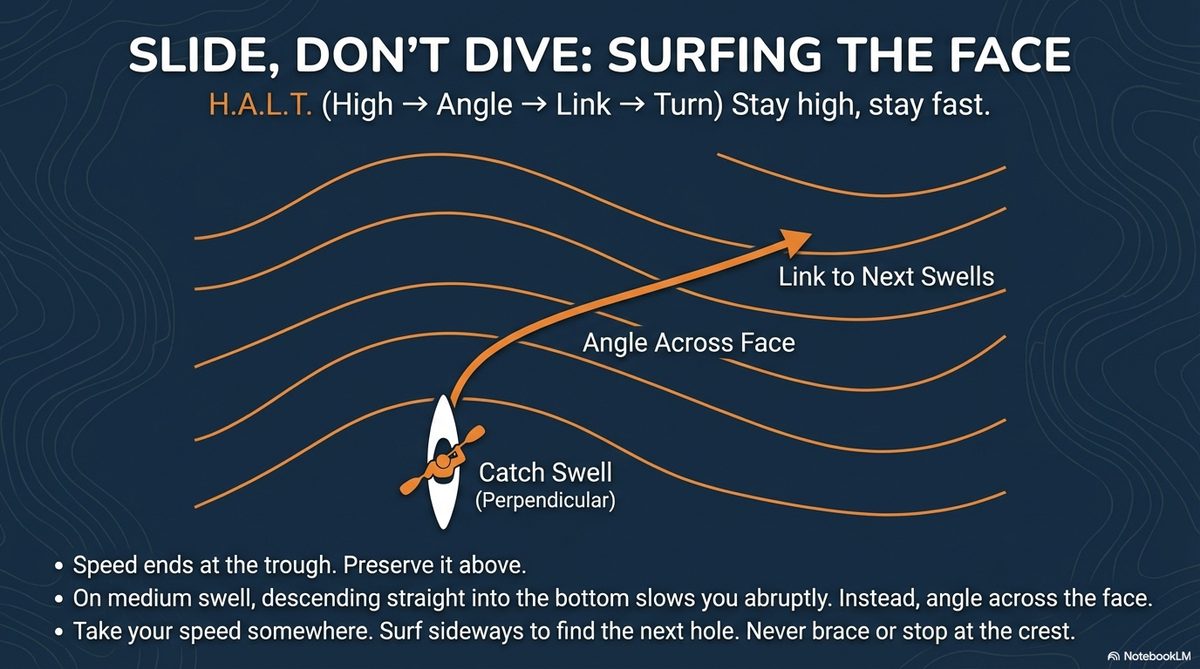
Elite paddlers avoid the “momentum grave” of the trough. Speed ends at the bottom of the wave; high-level surfing is the art of staying high on the face to link energy. Use the H.A.L.T. Strategy.
- High: Maintain your position on the upper third of the swell face.
- Angle: Direct the ski across the face rather than straight down.
- Link: Use that elevated speed to move laterally to the next swell.
- Turn: Execute the redirection before you hit the bottom.
Tactical Rules for Face Surfing
- Stay High: The trough is where momentum dies.
- Angle the Face: Redirect speed sideways to find the next link.
- Limit Bracing: Bracing at the crest destroys all potential energy — mechanical failure.
- Slide, Don’t Dive: Surfing sideways preserves your height and speed.
On medium swell, descending straight into the bottom slows you abruptly. Instead, angle across the face and take your speed somewhere. Surf sideways to find the next hole. Never brake or stop at the crest.
B³ Principle
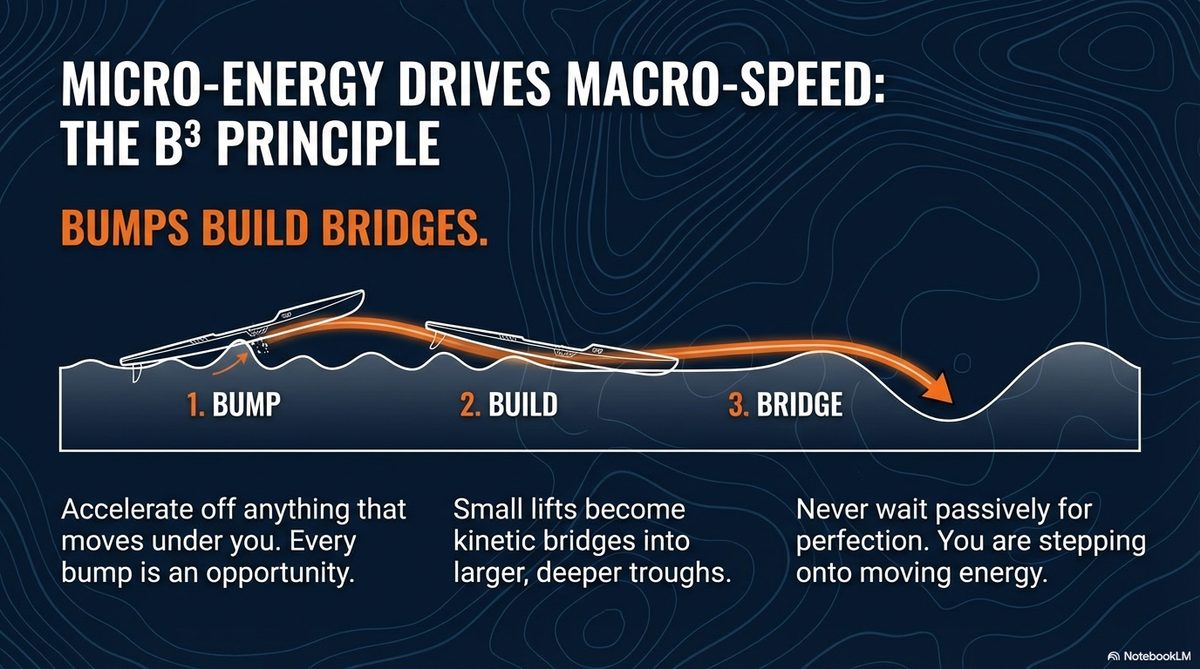
Passive waiting is the enemy of rhythm. Use micro-energy — the small wind chop — to bridge the gaps between larger swells. This is the B³ Principle: Bump → Build → Bridge.
- Bump: Accelerate off micro-energy. Accelerate off anything that moves under you.
- Build: Use that small lift to gain the speed needed for the next level.
- Bridge: Use that momentum to cross the “dead water” and enter a larger trough.
The Bridge Effect
Two large, parallel ground swells separated by a gap of “flat” water containing small wind chop. The ski’s path: catch a small Bump, Build speed, successfully Bridge the gap into the trough of the lead swell.
Accelerate off anything that moves under you. Every bump is an opportunity. Small lifts become kinetic bridges into larger, deeper troughs. Never wait passively for perfection — you are stepping onto moving energy.
The T·N·R Reset
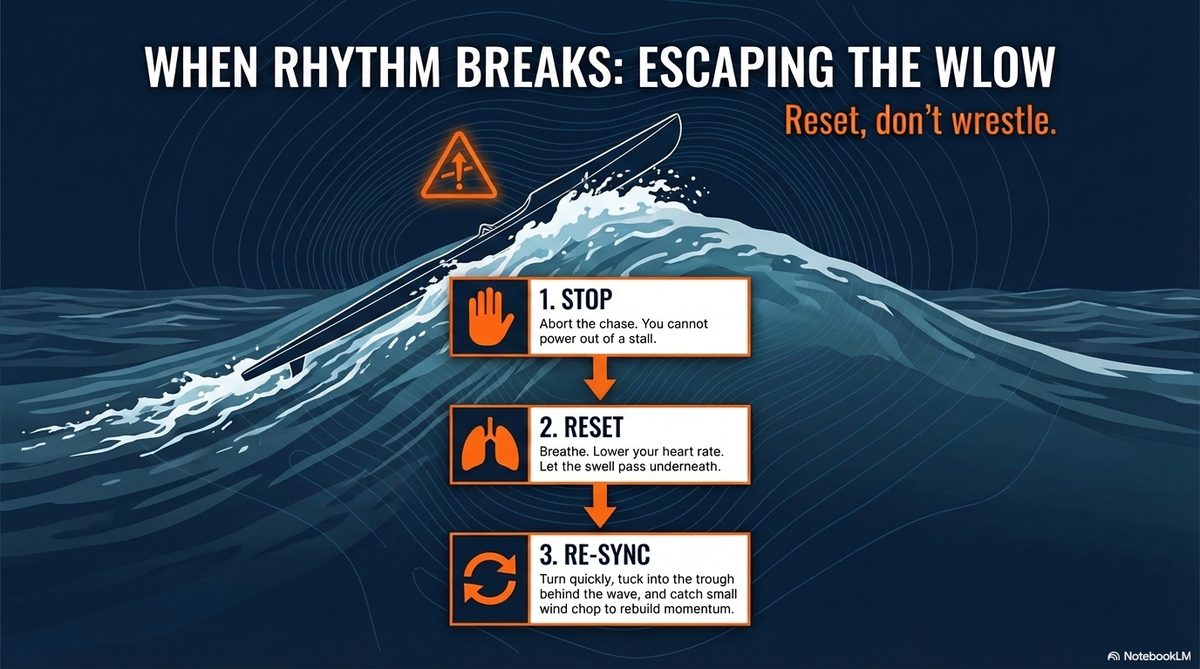
Stalling is a mechanical failure. When you lose the rhythm, do not waste energy “wrestling” the boat uphill against the back of a wave. You must recognise the T.N.R. signs and execute a reset immediately.
Warning Signs — The Wallow Checklist
- The tail feels heavy and repeatedly drops.
- The nose lifts, losing engagement with the water.
- Increased paddling cadence results in zero hull acceleration.
- The boat feels like it is moving “uphill.”
The Reset Sequence
- Stop: Give up the chase. You cannot power-on a stall.
- Reset: Breathe. Lower your heart rate. Let the swell pass underneath.
- Re-Sync: Turn sideways, lock into the trough behind the wave, catch small wind chop to rebuild rhythm.
The Turn-and-Tuck
Redirect 20° away from the current wave to line up perpindicular into the energy of the swell immediately following. The trough behind you is your reset zone.
The S·C·S Principle
Instability creates hesitation, and hesitation kills speed. To paddle fast, you must first be stable. This is the S.C.S. Principle: Stability → Comfort → Speed. A relaxed posture allows for better cadence control and earlier commitment to drops.
The Sequence
- Stability First: A secure foundation is the prerequisite for speed. Brace, balance, and centre yourself before chasing runs.
- Comfort Follows: Relaxation in the cockpit allows better cadence control. Tight muscles slow reaction time.
- Speed is the Outcome: When you are stable and comfortable, you commit earlier and drop more aggressively into runs.
Posture Cues
- Centred in the cockpit with a relaxed, upright posture.
- Balance vectors extend equally to both sides.
- Rhythmic, intentional stroke — not a frantic, stabilising brace.
Paradox: Trying to go faster by paddling harder when unstable will make you slower. Settle first, then accelerate.
Lean to Lead
Your body lean is a tool for influencing the hull’s carve. The direction of the lean changes based on your phase of movement. This is governed by the A.S.S. Mnemonic: Approach = Same lean; Surfing = Sometimes opposite.
The A.S.S. Mnemonic
- Approach Phase: Lean toward the direction of your turn to counter roll and initiate entry.
- Surfing Phase: To turn left while surfing,lean right to force the hull to carve the turn.
Hull Carve Mechanics
The ski is surfing a swell trending right. To execute a left-hand turn, lean the ski to the right. The hull carves a left-hand arc as a result of the lean. Counter-intuitive — but this is how hull geometry works under load.
Lean Logic Summary
- Approaching a turn: lean same direction as the turn (counter the roll).
- Surfing a swell: lean into the swell face to carve the hull away from it.
- Practice this on flat water first — the sensation is initially counter-intuitive.
C³ Safety
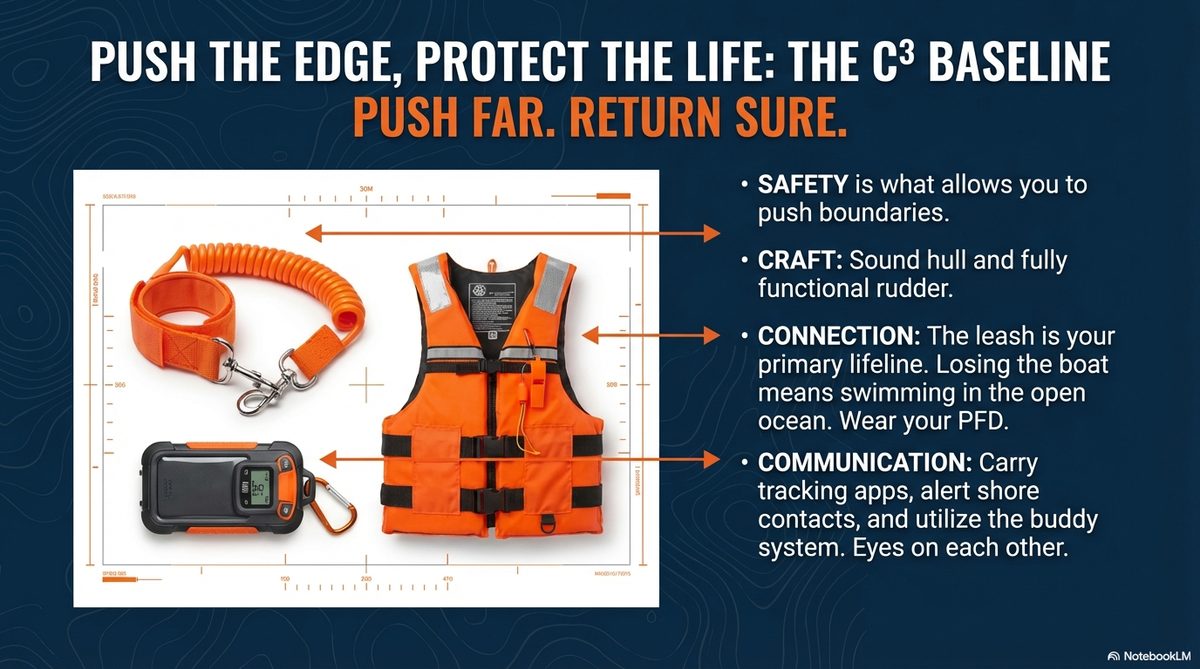
Safety is the non-negotiable foundation of performance. You cannot push your limits if you cannot return to shore. Always verify the C³ elements before launching.
Mandatory Safety Checklist
- Craft: Inspect for a sound hull and fully functional rudder/cables.
- Connection: Your leash is your lifeline. Ensure it is secure and functional. Never separate from the boat.
- Communication: Wear a certified PFD. Dress for water temperature, not air temperature. Carry a communication device (VHF/Phone) and log your route.
Protocol
- Paddle with companions whenever possible.
- Safety is what allows you to push boundaries. The craft is your primary flotation — guard it.
- Losing the boat means swimming in open ocean. The leash is your lifeline.
SAFETY enables performance. Every elite paddler has a conservative safety foundation. Return first. Improve next.
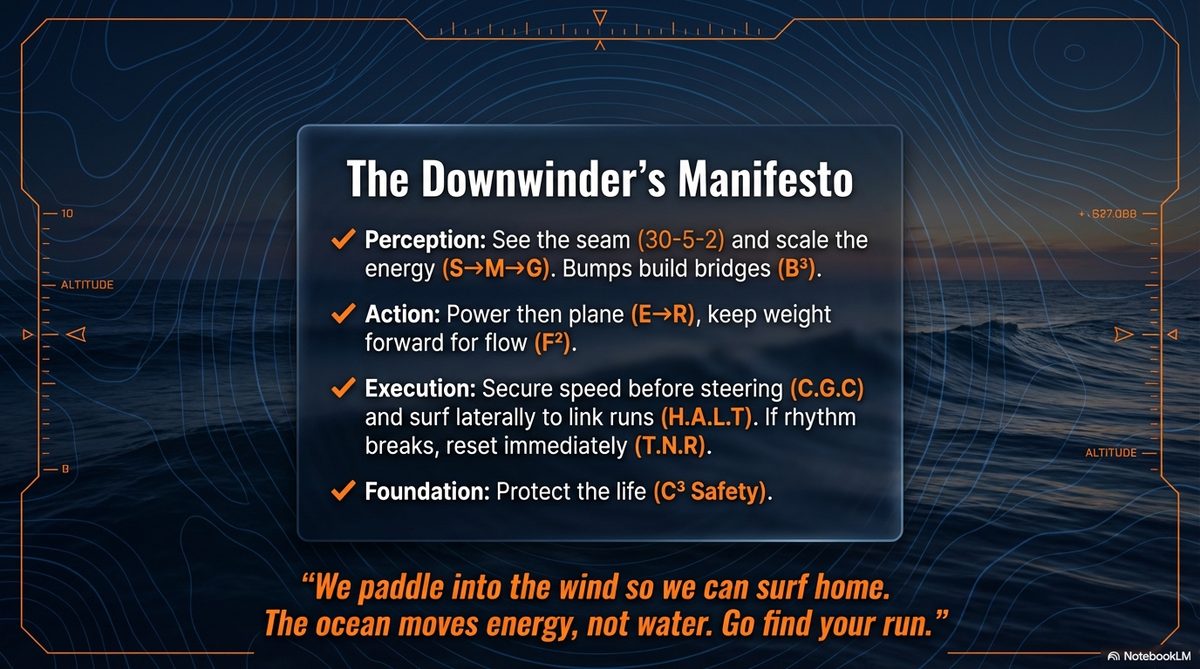
The Downwinder’s Manifesto
- ✓Perception: See the seam (30-5-2) and scale the energy (S→M→G). Bumps build bridges (B³).
- ✓Action: Power then plane (E→R). Keep weight forward for flow (F²).
- ✓Execution: Secure speed before steering (C.G.C.). Surf laterally to link runs (H.A.L.T.). If rhythm breaks, reset immediately (T.N.R.).
- ✓Foundation: Protect the life (C³ Safety). Return first. Improve next.
We paddle into the wind so we can surf home.
The ocean moves energy, not water. Go find your run.