

| Paddler | Brian Roberts |
| Boat | Stand-Up Paddleboard (SUP) |
| Course | Long Course |
| Year | 2026 |
| Finish Time | 5:33:59.0 |
| Training Distance | 450 km since 1 January 2026 |
| Class | Only SUP entrant in the long course |
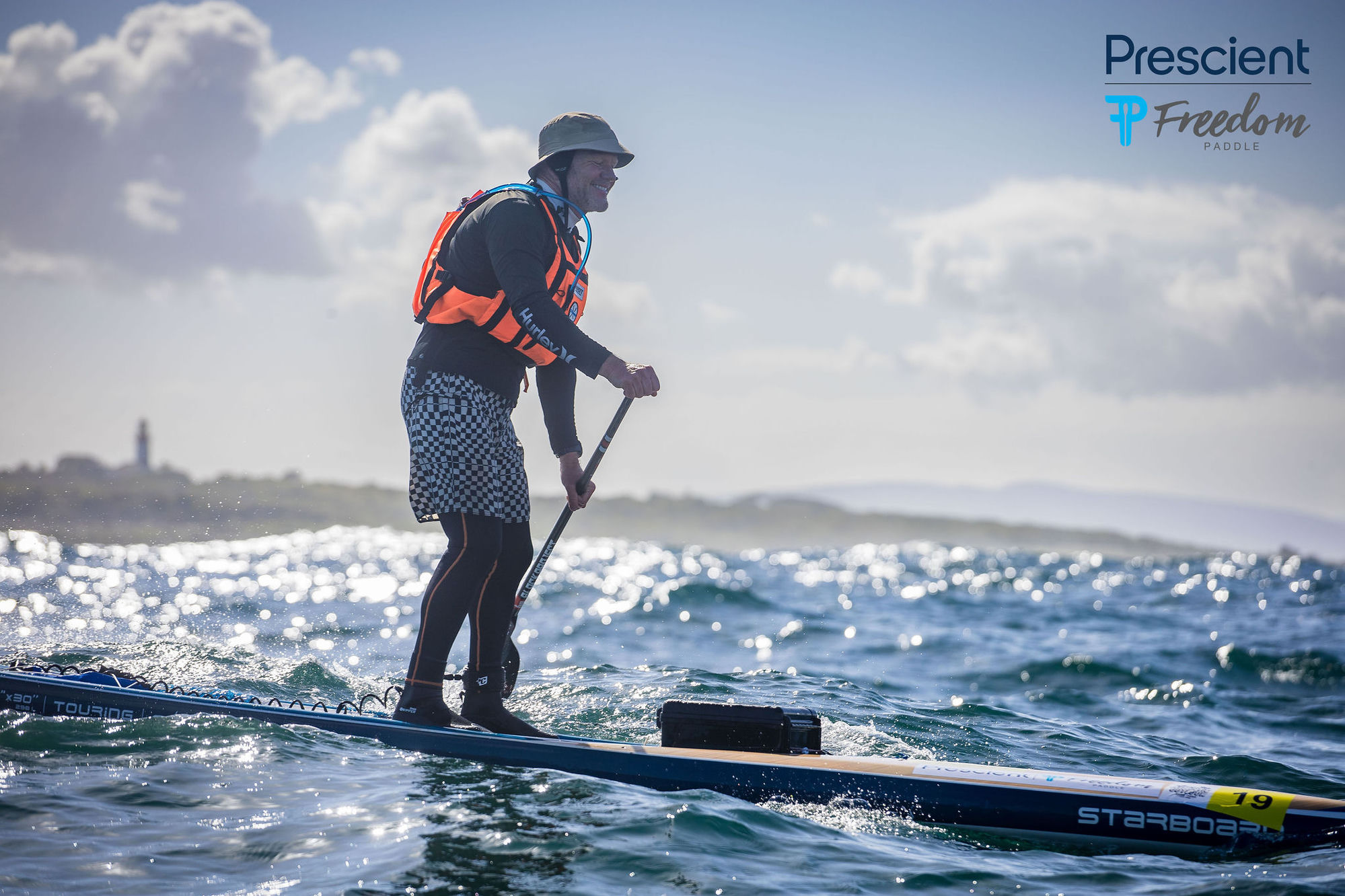
I started surfing when I was about six years old. I turn 59 this month, and in the 53 years since I first paddled out, I’ve done just about every ocean activity you can imagine. For the last ten years I’ve been surf SUP’ing. I switched to it when I realised that competing for the inside with the younger generation on a surfboard was becoming harder and harder. Surf SUP’ing gives me far more waves and the confidence to head out on my own in less crowded spots.
If quantity over quality is what you’re after, surf SUP’ing is a great option.
A New Challenge
I had never done any long-distance SUP’ing in those ten years — I surfed for fun and ran for fitness. After a disastrous Cape Town Marathon in 2024 (crippling cramps), I decided I needed a new challenge. That’s when I joined the Dolphin Coast Paddlers and started doing a few SUP sessions on the dam. If the sea was good, I surfed. If it was bad, I headed to the dam.
I can’t remember exactly how I first heard about the Prescient Freedom Challenge (must be an age thing). When I found the event online, it sounded like a solid fitness goal. I committed to the race at the end of 2025 with no real idea what I was letting myself in for — I’d deal with that later.
I downloaded a marathon running programme, figuring the principles were the same: I just needed to be fit enough to keep going for five hours, whether paddling or running. I also made a conscious decision to train in the sea whenever possible. On my first downwind run, my wife dropped me 7 km from my home beach. I fell about 20 times. It was exhausting and embarrassing! Thankfully I’m the only long-distance SUP’er in the area (turns out, in the whole country), so no one was watching.
I stuck with it. After reading about the Robben Island crossing and watching some videos, I realised this race was unlikely to be a pure downwind, crosswind was more probable. Fortunately, crosswinds and headwinds are much easier on a SUP than downwinds. I gave up the downwind sessions and focused on out-and-backs. If the wind was howling and the swell was running, I still went. My training was all time-based, so if I needed to do 90 minutes, it didn’t matter how far I travelled. I concentrated on a metronomic stroke rate of 36–40 strokes per minute, regardless of the conditions. My biggest differential was nine minutes a kilometre: 15 minutes a kilometre into a ridiculous headwind, then around six minutes a kilometre on the way home.
The Only SUP in the Field
Only after entries had been open for two months did I start worrying that I was the only person entered for the long course on a SUP. Hell, what had I got myself into? I took some comfort that there was one entry on a prone board — until Robin told me he had “ticked the wrong box.” Damn. Back to being the only one.
My biggest worry was that everyone would have to wait for me at the finish. Then I saw I was due to start earlier than everyone else, with the plan that we would all finish around the same time. Phew! I had already done 450 km of training since 1 January, all on my own, so heading off early and paddling solo didn’t bother me.
The week before the race had a few nervous moments. First, SUP South Africa messaged me basically asking, “Do you know what you’ve entered?” Then Robin and Richard phoned to say the forecast for race day looked bad and suggested I consider dropping to the short course. I asked if I could think about it and that we could decide together the next morning.
I rationalised my decision by reminding myself this wasn’t life-or-death. I’m extremely comfortable in the ocean, there were safety boats everywhere, and if it got too tough, I could always get a lift. Robin and Richard were happy with that logic. It was only at 07h00 on race morning that I made the final call to do the long course. A huge thanks to them for taking such an interest in my safety and for being so reasonable with the one (slightly irritating) SUP’er who was determined to do the full distance.
Out on the Water
I headed off at 07h00 with two single sculls. They pulled away quite early, but I could see the safety boat’s flag with them all the way to the 19 km mark. I only fell once in five and a half hours. I’m a fanatical birder, and about 2 km from the start I was watching penguins and promptly fell in. I decided then and there that today was not a good day for birding.
The first part of the crossing was very pleasant — challenging, with the odd bump, but enjoyable. My plan was to take my first proper break (sitting on the board to eat) at 10 km. Sitting on the northeastern corner of the island on the leeward side was incredibly peaceful. I hadn’t seen another soul. I sent my hard-core support crew (wife and kids) a video of the island and Table Mountain behind me.
The next 3 km were also good. For the first 13–14 km I was averaging 8–9 minutes per kilometre — right on target for a four-hour paddle. Then at 14 km I rounded the corner onto the wild side.
The Wild Side
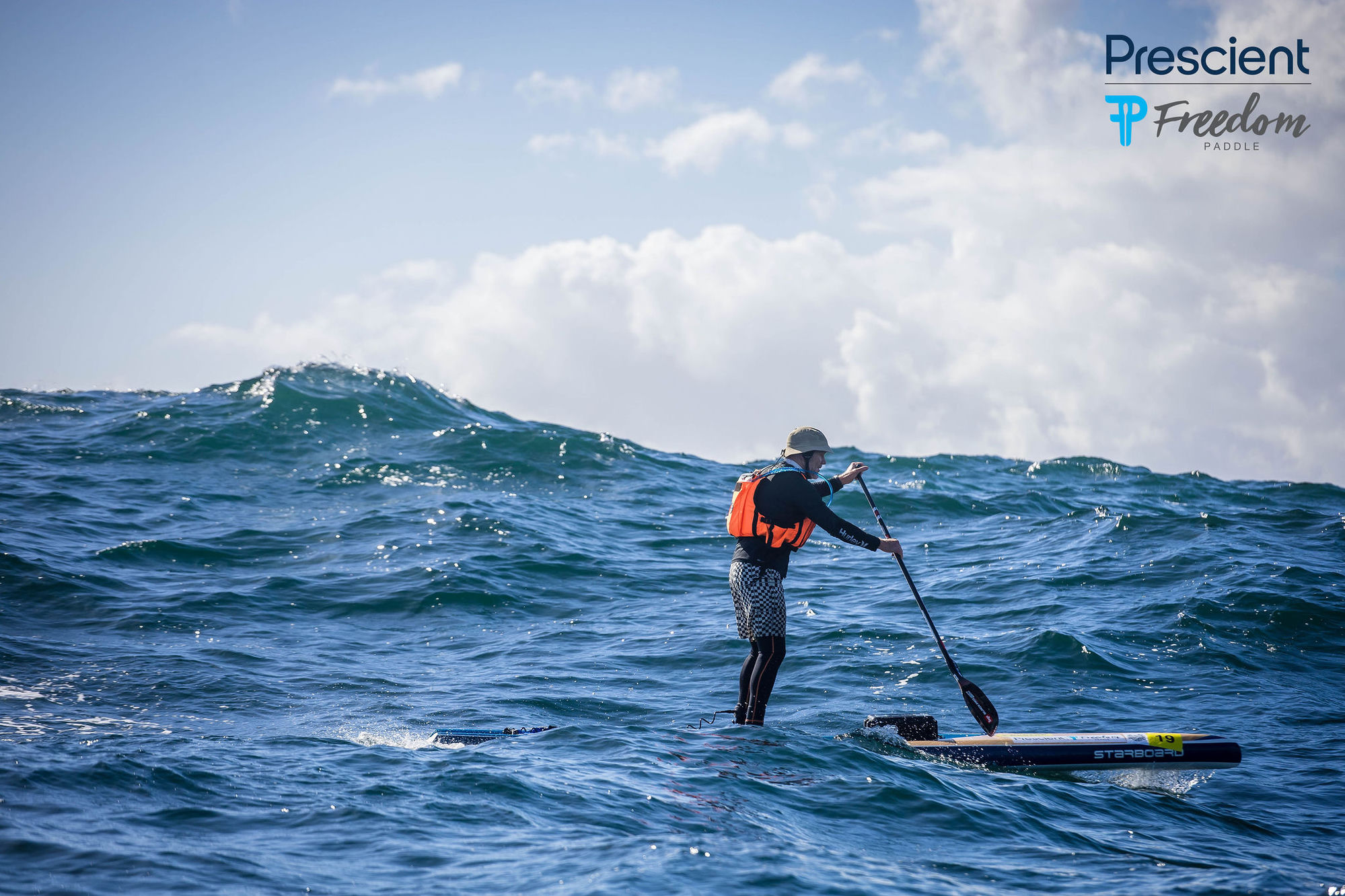
So much for beautiful photos of the wreck and Madiba’s lefts. The waves were big and the wind was strong. My 8–9 minute kilometres became 12–14 minutes. For the first time I wished I wasn’t alone. I had no idea how wide I needed to go to avoid the sets breaking in front of me. That, in my opinion, was the only real risk. I spotted the flag on the safety boat with the two sculls about 1–2 km ahead and decided to follow their line.
I never once felt in danger. I was whooping out loud to the birds as I paddled over the massive open-ocean swells. It was exhilarating — beautiful in its chaos, as only the ocean can be.
The first paddlers to pass me were the coastal rowers, at around 17 km. They had a good chirp about how mad I was. They weren’t the only ones, but it was nice to finally have some company out there. I stayed on the wide line along the wild side until 19 km. From there I could see the stadium and no breaking waves between me and home.
I had no idea how many extra kilometres the wide detour around the wild side had added to the official 27 km. I could have checked, but I decided I’d rather not know. I was going to finish either way.
The Long Paddle Home
The paddle home was tough. The wind swell and ground swell were coming from different directions, and everything was off my right shoulder. A SUP has no rudder — you steer with the paddle and by shifting your weight. To keep the nose pointing at the stadium I paddled the entire 11.5 km home on my left side. This was nothing like my training (“10 on the right, 10 on the left”). I was worried about cramping, but thankfully I stayed strong. I was fatigued for the last 90 minutes, so I slowed my cadence and just kept repeating in my head:
“Walking pace, Brian… anyone can walk home.”
It took forever. A fishing trawler hooted at me about 3–4 km from the finish. I gave them a zap and they shouted and swore at me. That burst of adrenaline lifted my spirits, and I actually enjoyed the last few kilometres once we got into a bit of a wind shadow.
I hadn’t looked at my watch since the four-hour mark, I was too scared. It was easier to trick myself that I wasn’t stuffed if I didn’t know how long I’d been out there. By then it was no longer about time; it was just about finishing. When I finally crossed the line, I stopped my watch: 5 hours 30 minutes. I asked the safety boat if he was the sweeper and whether I was last. I wasn’t. Phew, I hadn’t kept everyone waiting!
What an adventure. Definitely not what I expected. I had been warned it wouldn’t be a cakewalk, but it was tougher than I could have imagined. In hindsight, should I have dropped to the short course? No frigging chance!
Thank you to everyone, especially Robin and Richard for letting me “give it a shot,” the photographers on the safety boats for the entertaining chirps, and all the support out on the water. My favourite part was seeing the pride on my family’s faces. Luelle, Josh and Megan looked at me like I was cool again. The kids say I used to be cool before I became a birder. After this race, I’m cool again, at least for now. Being a cool dad at 59 is a win!
I will 100% enter next year. I’m trying to rally some company. I don’t think I’ll do the long course if the conditions are bad, I’ve been there, done that, but I’d love to do it in good to moderate conditions where I can paddle all 27 km “10 on the right, 10 on the left.”
See you next year!
Regards
— Brian Roberts | 2026 Prescient Freedom Paddle | SUP Long Course | 5:33:59.0


